
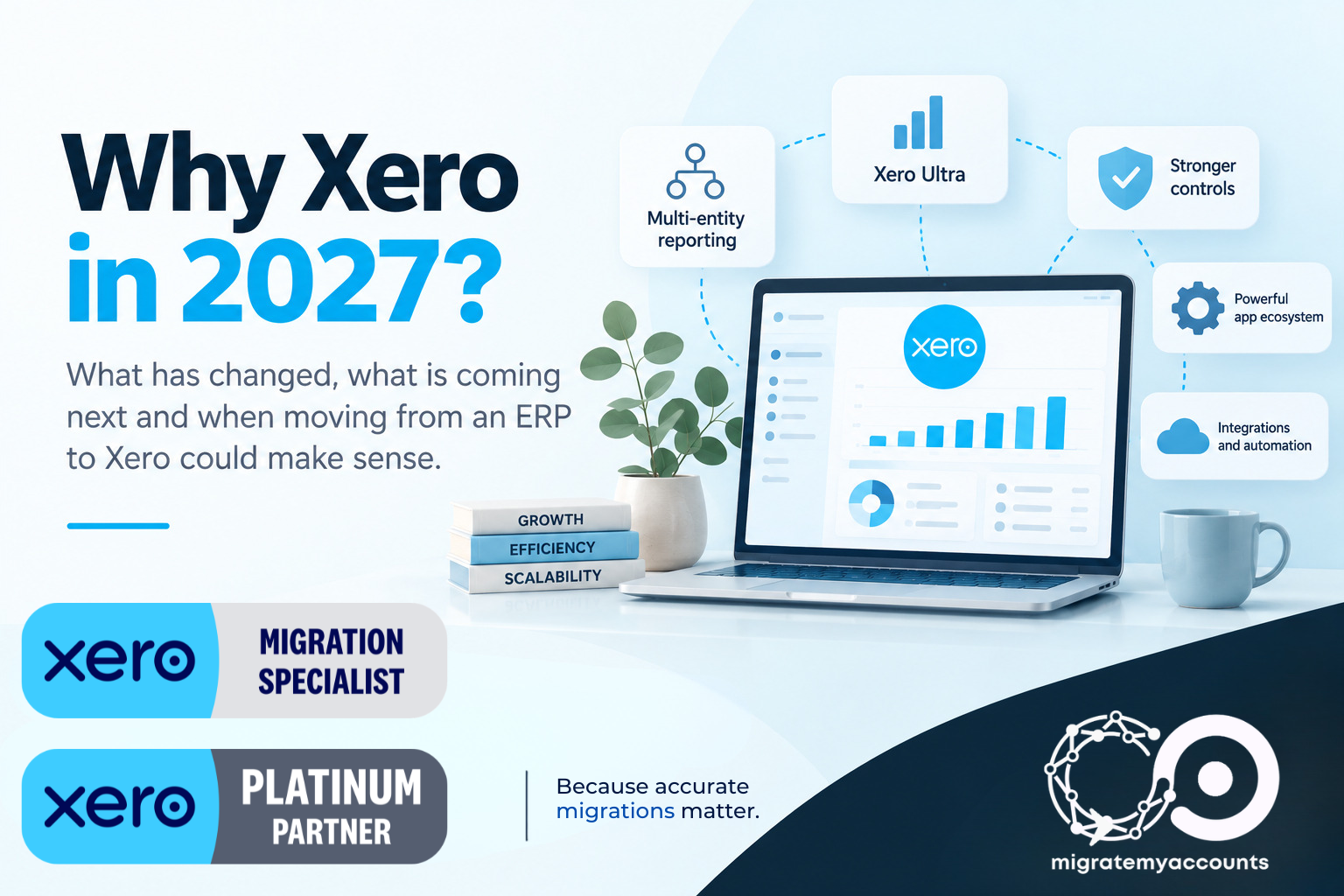
The Xero you remember is not necessarily the Xero you are evaluating for 2027
Xero still describes itself as a global small-business platform, and simplicity remains one of its strengths. But 2026 has also brought a much more explicit push into growing-business complexity: Xero Ultra, Syft-powered analytics, multi-entity consolidated reporting, enterprise-style controls, AI-assisted workflows, benchmarking, deeper integrations and a continually expanding app ecosystem.
For businesses on Sage 200, Access Dimensions, Business Central, Sage Intacct, Exchequer and other legacy or ERP systems, that matters. The decision is no longer simply “basic cloud accounting versus ERP”. There can be a third architecture: Xero as the financial ledger, specialist applications for specialist operational jobs, and integrations connecting the wider finance process.
That distinction matters because software decisions are often made using memories of a product rather than its current shape. A finance team may have ruled Xero out years ago because group reporting, controls, integrations or scale felt too limited. Those concerns may still be valid for a particular organisation, but they deserve to be checked again against the 2026 product and ecosystem rather than carried forward automatically.
Equally, “new” does not mean “right”. We would still start with the finance and operational requirements, not the software name. The useful question for 2027 is whether the business still needs a large integrated ERP, or whether a Xero-centred architecture can now do the financial job more simply while specialist applications handle the operational work.
7 reasons we think Xero deserves another look in 2027
1. Xero Ultra moves deliberately into scaling-business territory
Ultra launched in Australia in July 2026 and Xero showcased it at Xerocon London. Xero's own language focuses on more entities, more complexity, more transactions, stronger control and deeper insight.
This is important beyond the plan itself. Xero describes Ultra as a route to stronger financial control and sophisticated reporting without automatically taking on the cost and implementation burden of a traditional ERP. In Australia, Ultra includes Syft Advanced, priority support and targeted data restore. For us, the significance is not that every medium-sized business should move to Ultra. It is that Xero is deliberately addressing requirements that used to sit much closer to the ERP conversation.
2. Multi-entity reporting is becoming a much stronger proposition
Syft Advanced changes what a group can do around consolidation, forecasting, scenarios, KPIs, benchmarking and dashboards. That can remove one of the historic objections raised by multi-company finance teams.
Xero’s September 2026 Ultra training goes further than a headline about consolidation. It covers connecting data sources, chart-of-accounts layouts, benchmarking, custom KPIs, segments and ledgers, non-financial data, budgets, cash-flow forecasting, dashboards and AI-powered insights. For groups, that means the reporting layer can be designed around the group rather than forcing every reporting requirement into each individual ledger.
3. The app ecosystem is a feature, not a workaround
A business does not necessarily need inventory, approvals, intercompany, ecommerce and forecasting to be native modules in one accounting product. A well-designed Xero ecosystem can let each specialist tool do its job while keeping the ledger cleaner and easier to operate.
This modular approach can be a strength when it is designed deliberately. Inventory might sit in a stock application, approvals in an approval platform, intercompany in a specialist tool and group reporting in Syft, while Xero remains the accounting core. The trade-off is that integrations, ownership and support need to be mapped properly. A collection of apps chosen without an architecture can become just as awkward as an overgrown ERP.
4. Automation is moving beyond simple bank rules
JAX and XeroForce point towards finance workflows that can reconcile, identify anomalies, follow up payments and connect Xero with the tools teams already use. Human review and accounting responsibility still matter, but the workflow layer is changing quickly.
At Xerocon London 2026, Xero described XeroForce as a natural-language agent builder and highlighted integrations that bring live Xero financial data into tools such as Microsoft 365 and Claude. Some capabilities are still early-access or evolving, so we would not build a business case around a roadmap promise. But the direction matters: automation is moving closer to the finance workflow itself rather than being limited to repetitive bookkeeping steps.
5. Reporting and insight are becoming more sophisticated
Industry benchmarking, dashboards, external/non-financial data and AI-assisted insight increasingly move Xero beyond retrospective bookkeeping.
The practical change is that finance teams can ask for more than a month-end profit and loss account. Benchmarking, custom KPIs, scenario work, forecasts and non-financial data can help management look forward as well as backwards. That does not remove the need for good accounting data. In fact, richer analytics make clean coding, consistent dimensions and a well-designed migration even more important.
6. A lighter system can reduce ERP overhead
Some organisations are paying for infrastructure, licences, consultants or read-only access simply to preserve a system whose operational role has shrunk. Where requirements permit, a simpler architecture can be attractive, but only after the data and processes are properly mapped.
That saving is not just the subscription price. ERP cost can include infrastructure, upgrades, specialist consultants, custom reports, integrations, training and the internal time required to administer the platform. A Xero-centred stack has its own app and support costs, so the comparison needs to include the whole architecture. The opportunity is simplification, not a promise that cloud accounting is automatically cheaper.
7. Historical data does not automatically have to be sacrificed
One of the assumptions we encounter is that leaving an ERP means taking opening balances and archiving everything else. That is not how we approach migration. Depending on the source, volume and required structure, detailed historical transactions, allocations, VAT, tracking, currencies and other accounting history can often be migrated and reconciled into Xero.
For us, this is central to the decision. A business should not have to choose between modernising its finance platform and keeping useful accounting history. The right amount of detail varies by organisation, and some high-volume data may sensibly be consolidated, but the migration strategy should be decided from reporting, audit and operational needs rather than from an assumption that only a trial balance can move.
What does a Xero-centred finance architecture look like in 2027?
For a more complex business, choosing Xero does not have to mean asking one product to do everything. We increasingly think in layers: the accounting ledger, operational systems, control and approval tools, reporting, and the integrations between them. That is a different design philosophy from a traditional ERP, where many of those jobs are expected to live inside one platform.
| Layer | Possible role in a Xero-centred stack | What needs designing |
|---|---|---|
| Financial ledger | Xero holds the accounting records, bank activity, receivables, payables and core financial reporting. | Chart of Accounts, currencies, tax, tracking and transaction design. |
| Operational systems | Specialist applications can manage stock, ecommerce, time, projects or other industry workflows. | Which system owns each record and what should post to Xero. |
| Controls | Xero permissions plus approval and payment tools can support finance governance. | Approval thresholds, segregation of duties and audit evidence. |
| Group insight | Syft and other reporting tools can consolidate entities and provide dashboards, forecasts and KPIs. | Entity mapping, eliminations, reporting structures and consistent coding. |
| Integration | APIs and automation connect the finance stack. | Error handling, ownership, monitoring and what happens when an integration fails. |
The benefit is flexibility. The risk is fragmentation. We would not recommend replacing one complicated ERP with six disconnected applications and calling that simplification. The architecture needs a clear system of record, sensible data flows and somebody responsible for each integration.
Xero vs ERP in 2027: start with the workload
| Question | Xero-centred architecture may suit when… | An ERP may still suit when… |
|---|---|---|
| Financial reporting | Finance needs strong accounting, group insight and connected reporting. | Reporting depends on deeply integrated operational ERP data models. |
| Inventory / operations | Specialist connected apps can own operational workflows. | Complex MRP, production, warehouse and planning are inseparable from the finance platform. |
| Entities | Multiple Xero organisations plus consolidation fit the group model. | The group requires unusually complex centralised transaction processing. |
| Controls | Xero permissions plus approval/control apps meet governance needs. | Very granular native roles and workflow controls are mandatory. |
| Change appetite | The business wants a simpler, modular cloud stack. | The ERP is genuinely delivering value across the whole operation. |
What about Xero's limitations?
They still matter. We do not think “Xero Ultra exists” is a reason to ignore transaction profiles, API throughput, tracking design, inventory requirements, permissions, reporting or operational workflows. What has changed is that some historic objections need to be retested rather than repeated.
For example, Xero now explicitly talks about Ultra supporting more transactions and complexity. That is not the same as publishing a promise that every dataset of every size will perform perfectly. For a serious ERP exit, we would scope volumes by transaction type, test the proposed structure and decide what should be migrated in detail, consolidated or retained elsewhere.
Migration limits and live-system limits are not the same thing
This distinction is often missed. A migration can be technically demanding because an API has throughput constraints or because a source ERP contains millions of detailed lines. That does not automatically mean the resulting Xero organisation will be unsuitable in daily use. Conversely, being able to import a dataset does not prove that the proposed live workflow is sensible.
We therefore look at invoice counts, bills, bank transactions, journals, contacts, currencies, allocations and reporting dimensions separately. We also look at what will continue to be created each month after go-live. Sometimes the right answer is full detail. Sometimes historic operational detail is better retained outside the ledger while accounting-level history is migrated in a controlled form.
Ultra does not remove the need for testing
Xero's positioning around more transactions and greater complexity is encouraging, but we would still test a proposed design for a high-volume or unusual business. The objective is not to prove that Xero can be made to accept the data. It is to make sure the organisation remains usable, supportable and understandable for the finance team after the migration project has finished.
A practical way to decide whether Xero deserves a place on the shortlist
We would start with the workload rather than a feature checklist. Document what the current system actually does, which processes finance genuinely values, which customisations are historical baggage, and which operational jobs could sit elsewhere. Then map those requirements to Xero, Ultra where relevant, and the proposed connected applications.
Next, test the difficult parts. If the group has unusual consolidations, prove the reporting design. If transaction volumes are high, model the monthly profile. If the business depends on stock or project workflows, validate the integration before committing to the migration. If historical detail matters, establish exactly what can be extracted from the source and how the migrated result will reconcile.
Where we see Xero fitting increasingly well
- Professional-services and service-led groups with several entities.
- Businesses whose ERP is primarily being used as an accounting ledger rather than a true operational ERP.
- Organisations that want specialist applications for inventory, approvals, intercompany or reporting rather than one monolithic system.
- Groups that value cloud access, a broad integration ecosystem and simpler finance-team usability.
- Businesses prepared to redesign legacy coding rather than reproduce decades of ERP complexity.
Where Xero may still not be the right answer
- Complex manufacturing and MRP requirements that genuinely depend on the ERP.
- Very specialised warehouse, logistics or operational workflows without a suitable connected application.
- Control requirements that cannot be met through Xero and the proposed app stack.
- A transaction profile that testing shows is unsuitable for the intended Xero design.
- A business whose current ERP is working well and whose replacement case is based only on fashion rather than a real problem.
What this means for ERP-to-Xero migration
The destination is getting stronger; the migration does not become automatic. Historical accounting data still needs to be extracted correctly, transformed into Xero's model, imported in a controlled sequence and reconciled. ERP dimensions need decisions. Foreign currency needs care. Allocations, VAT and control accounts need evidence.
That is the part we specialise in. We have worked with complex and multi-entity migrations into Xero across the UK and internationally, and our role is as much about saying what should not be copied one-for-one as it is about moving the history.
Do not rebuild the old ERP inside Xero
One of the easiest ways to make a new system unnecessarily complicated is to reproduce every old nominal code, department, contact convention and workaround simply because it exists. Migration is an opportunity to decide what still has a purpose. Old dimensions may become Tracking, be consolidated, move into a reporting tool or disappear entirely if nobody uses them.
Historical data needs its own decision
Opening balances can be appropriate for some projects, but they are not the only migration model. Detailed history can be valuable for audit trail, customer and supplier enquiries, comparative reporting and confidence when the legacy system is eventually switched off. The right answer depends on volume, source quality and how the business will use the history after go-live.
Validation is part of the migration, not an optional final check
A successful cutover should leave evidence. We expect to be able to compare the agreed source position with Xero, investigate differences and explain any deliberate transformations. A modern destination does not compensate for an unexplained opening balance or missing transaction history.
Read our detailed Xero Ultra guide → · Explore ERP to Xero migration →
Questions to ask before deciding on Xero for 2027
- What jobs is our current ERP actually performing today?
- Which of those jobs belong in the accounting ledger?
- Which would be better handled by specialist connected applications?
- What historical detail do finance users genuinely need live?
- What are our real monthly transaction volumes by type?
- How many entities, currencies and reporting dimensions are involved?
- What approval and segregation-of-duties controls are mandatory?
- How will the migration be reconciled back to the source?
- What will we save, and what new app/support costs will we introduce?
- Can we test the proposed architecture before committing to the final cutover?
Why Xero in 2027: common questions
Does Xero Ultra mean every medium-sized business should move to Xero?
No. Ultra expands the conversation, but operational requirements, controls, transaction profile, integrations and reporting still decide whether Xero is a sensible fit.
Is Xero Ultra available in the UK?
As at 29 September 2026, Xero has showcased Ultra in London but it is not listed as a standard plan on the UK pricing page. Australia is the live market we can point to today, so UK availability should be confirmed directly with Xero before making a plan-dependent decision.
Can a business move from an ERP to Xero and keep historical data?
Often, yes. The feasible level of detail depends on the source system, data quality, volumes and the structure required in Xero. We scope this rather than assuming that an ERP exit means opening balances only.
What is the biggest mistake when comparing Xero with an ERP?
Comparing product names instead of workloads. The useful comparison is between the complete future-state architectures: what sits in the ledger, what sits in specialist applications, how controls work, how reporting works and how the systems exchange data.
Our answer to “Why Xero in 2027?”
Because it deserves to be assessed on what it is becoming, not dismissed because of what it was originally known for. That does not mean choosing Xero by default. It means giving it a fair technical and accounting assessment alongside the ERP options: especially when the existing system is expensive, difficult to change or no longer aligned with how the business operates.