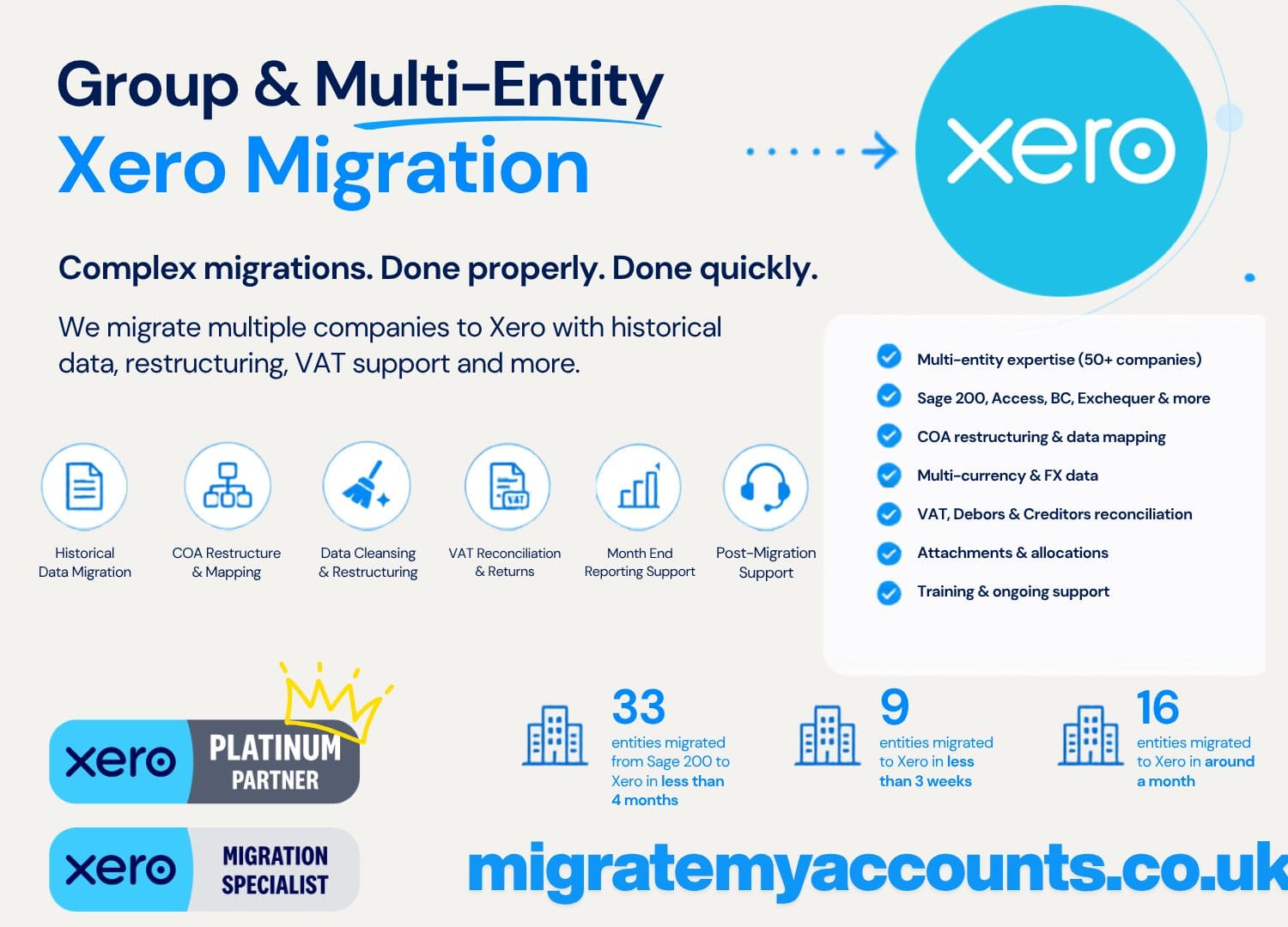
Group & Multi-Entity Xero Migration
Moving a group is not the same as moving one company several times. The entities, reporting structure, sequencing and reconciliation need to work together.
Plan the group before migrating the first entity
A group migration starts with the future structure. We review the source systems, entity volumes, financial years, VAT or GST, currencies, Chart of Accounts, departments or cost centres and the reporting structure required after go-live.
This is also the point to decide whether every entity should retain its existing structure or whether the migration is an opportunity to standardise codes and reporting across the group.
A group migration can be a restructuring opportunity
Multi-entity projects often expose years of different naming conventions, duplicate codes, inconsistent contacts and entity-specific workarounds. Where appropriate, we can map these into a cleaner group-wide Chart of Accounts and a more consistent Xero tracking structure.
The objective is not to rewrite historical accounting results. It is to agree how legacy structures should translate into the future environment while preserving a clear audit trail.
Phased migration reduces operational risk
Groups do not always need to wait for every entity to be ready at the same time. We can sequence migrations around year ends, audits, licence deadlines and operational priorities, starting with a pilot or lower-risk entity where useful.
Each entity can then be migrated, reconciled and signed off progressively, allowing lessons from the first migration to improve the remaining rollout.
Reconciliation has to work at entity level
Each Xero organisation needs its own evidence. Depending on scope, that can include Trial Balance, aged receivables and payables, VAT, bank balances, FX positions and mapping schedules. Group reporting or consolidation is then considered separately from the accuracy of each migrated ledger.
That distinction matters: a consolidated number is only as reliable as the underlying entities.
How we phase a multi-entity migration.
The first entity helps prove the extraction, mapping and reconciliation approach before the same rules are rolled across the wider group.
Discover
Review entities, volumes, years, VAT or GST, currencies and dependencies.
Agree structure
Confirm Chart of Accounts, contacts, tracking and group-wide mapping rules.
Pilot
Use an appropriate first entity to validate extraction, transformation and reconciliation.
Phase the group
Sequence remaining entities around size, reporting, VAT, month end and operational deadlines.
Reconcile
Validate each entity rather than relying only on a consolidated group result.
Handover
Document exceptions, cut-off points and the structure the finance team will use going forward.
Group migrations are a substantial part of our work.
Our projects include a 33-company Sage 200 to Xero migration containing 2.6 million transactions, delivered in under four months, and a 16-company Sage 200 to Xero migration completed in just over one month. The Care Concern relationship later expanded beyond the original 33-company project to further Sage 200, Xero-to-Xero and Pegasus Opera migrations.
These projects are why we plan the group structure first, then control the migration entity by entity.
Explore related migration expertise
Jump directly to the related service, guide or specialist topic.
Multi-company Sage 200 migration
How we plan, sequence and control a multi-company Sage 200 to Xero programme.
Explore →PlanningData restructuring
Standardise or redesign data structures across a group.
Explore →SystemSage 200 → Xero
Our specialist Sage 200 migration service.
Explore →CoreHistorical data migration
How we preserve and reconcile detailed accounting history.
Explore →SystemBusiness Central → Xero
Group migrations can start in Business Central too. Equiteq is one multi-entity example.
Explore →SystemSage 50 → Xero
PetBuddy is a two-entity Sage 50 group migration requiring a bespoke approach.
Explore →Common questions.
Can you migrate multiple companies at the same time?
Yes. We normally plan a sequence based on complexity, dependencies, go-live dates and the finance team's capacity to validate each entity.
Can we standardise the Chart of Accounts?
Yes, where a group-wide structure is agreed before migration. Existing codes can be mapped or consolidated without changing the underlying accounting result.
Can different entities go live on different dates?
Yes. A phased approach is often practical where entities have different audit, year-end or operational requirements.
Can you migrate foreign currency and tracking?
Yes, subject to the source data and agreed Xero design. We review currencies and source dimensions such as departments and cost centres during scoping.
Do you reconcile every entity?
Yes. Reconciliation and validation are performed at entity level within the agreed scope.
Tell us about the source system, history and future Xero structure.