Not every accounting data migration needs a specialist. And not every business is the right fit for Migrate My Accounts.
We tend to work best with businesses, finance teams, accountants and implementation partners who care about what happens to their accounting data, not simply how quickly somebody can move it from one system to another.
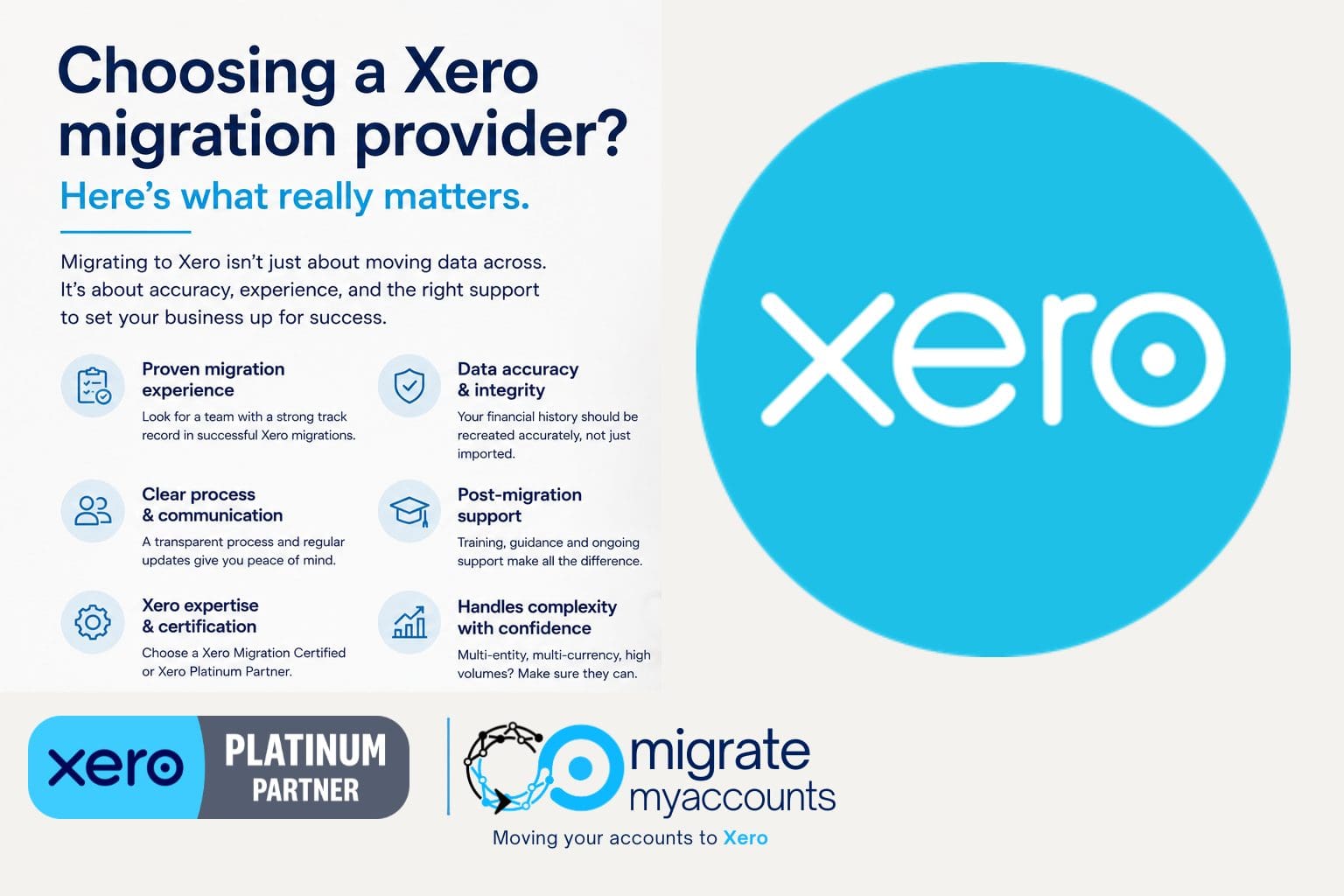
Choosing a migration provider is therefore about more than comparing prices or transaction counts. You need to understand how they think, how they validate the result, what happens when the data is awkward, and whether they will tell you when the answer is not the one you expected.
Working with MMA
You will probably enjoy working with us if...
Our best projects are collaborative, carefully checked and honest about limitations. These are the clients who tend to get the most value from that approach.
01
You care about getting the numbers right.
Overpayments, allocations across multiple invoices, foreign currency transactions, unusual journals and other exceptions are exactly where migration problems can hide.
If your attitude is “prove that the migration is right, don’t just assume it is”, we will probably get along very well. Reconciliation matters to you. So does an audit trail. And you are happy to scrutinise the result.
02
Your migration is genuinely complicated.
This is probably where we are happiest: multiple companies, years of history, foreign currencies, departments or cost centres, Chart of Accounts restructuring, attachments, large transaction volumes or legacy systems that do not produce beautifully structured exports.
Historical accounting data can matter for reporting, audit trails, customer and supplier history, management information and understanding how the business got to where it is today. Complexity is not an inconvenience around the migration. It is the migration.
03
You appreciate thoughtful advice, even when it challenges your assumptions.
You might come to us wanting every transaction from the last ten years moved into Xero. After reviewing the data, we might recommend migrating less. You might think opening balances are enough. We might explain why retaining historical transactions could be valuable in your situation.
Our job is not simply to say yes. It is to understand what you are trying to achieve and give you the best advice we can based on the data in front of us and our experience of accounting system migrations.
04
You prefer honest answers to impressive promises.
There are plenty of impressive promises in the migration industry. We would rather give you an accurate answer. If something cannot be migrated reliably, we will explain the limitation rather than manufacture a workaround that makes the migration look complete while damaging the integrity of the accounting records.
We use technology extensively, but automation is not a substitute for accounting judgement. Important decisions still need humans involved.
05
You want a relationship, not just a data import.
A system migration has a finish date. The relationship does not necessarily have to. We often continue helping clients after the data has moved, whether that means answering migration questions, helping the finance team understand Xero, supporting the first VAT return or simply being available when somebody finds something they do not understand.
We would rather become the people you trust with difficult accounting data than maximise the value of one transaction.
A useful filter
We might not be the right migration partner if...
You simply want the cheapest possible import, need somebody to promise that absolutely everything will transfer before the source data has even been examined, are not interested in reconciliation or reviewing the migrated data, or would prefer a completely automated migration where nobody questions the result as long as the software says it completed successfully.
There is nothing wrong with choosing a different approach. It just probably means we are not the best fit.
Our ideal client
The clients we work best with
Our best relationships tend to be with finance directors, financial controllers, finance teams, accountants, implementation consultants and business owners who understand that accounting data is an asset.
They do not necessarily know how to migrate it. That is our job. But they care about what arrives at the other end.
They value accuracy over shortcuts. They want an audit trail. They are comfortable asking questions. They appreciate advice, including when that advice challenges the plan they originally had.
And they understand that moving accounting systems is not only about moving data. It is about being able to trust that data afterwards.
So do we.
“
Moving accounting systems is not only about moving data. It is about being able to trust that data afterwards.
So do we.
What good looks like
Choose evidence over promises.
The original guide started with the question of how to choose a provider. That still matters. Look for relevant experience, a process they can explain, reconciliation that goes beyond “the import worked”, and honest limitations.
How should you compare accounting migration providers?
Do not compare them only on the number of transactions they promise to migrate or how quickly they say they can do it.
Ask how they validate the result.
Ask what will not migrate.
Ask what happens when source data is messy.
Ask how they deal with unusual transactions.
Ask whether you can review the data before go-live.
Ask what happens if something goes wrong.
Ask for real evidence of similar work.
And be cautious of absolute promises made before anybody has properly examined your data. A good migration provider should be comfortable answering difficult questions.
Choosing your provider
What should you look for in a Xero migration partner?
Price and transaction counts are easy to compare. The harder questions tell you much more about what will happen to your accounting data.
Evidence, not just a sales pitch
Look for real case studies, independent reviews and examples that resemble the migration you are planning. Ask a provider to explain a difficult project, what went wrong or nearly went wrong, and how they handled it. Big claims are easy. Specific migration evidence is much more useful.
For complex projects, system-specific experience matters too. Moving from Sage 200, Access Dimensions, Exchequer or Business Central is not the same exercise with a different file name. Each source system stores accounting history differently.
A process they can explain clearly
A migration provider should be able to explain how the project moves from scoping and extraction through mapping, trial migration, review, reconciliation and go-live. They should also be clear about who is responsible for decisions, what they need from your finance team and what will happen if the source data contains a problem.
If you want the detailed mechanics, our Xero Data Migration Guide covers the process without repeating it all here.
Reconciliation that goes beyond “the import worked”
For us, a migration is not successful because an import completed without an error message. The migrated accounting records need to be checked back to the source system and material differences need to be understood.
That can include the Trial Balance, aged receivables and payables, bank and control balances, VAT, foreign currency and targeted transaction-level checks depending on scope. Our Migration Validation & Reconciliation Guide explains those checks in detail.
A Trial Balance that agrees is useful. It is not, by itself, proof that a migration is complete.
Honest limitations
Accounting systems are structurally different. Some records translate beautifully; others do not have a direct equivalent in Xero. There can also be API limits, data-quality problems and source-system features that simply cannot be recreated exactly.
A good migration partner should tell you what will not migrate, what will change and where judgement is required before those things become surprises.
Ask difficult questions
Questions you should ask any accounting data migration provider
A good migration provider should be comfortable explaining how they validate the result, handle exceptions and deal with things that do not map neatly.
The clients we enjoy working with tend to ask questions. Lots of them. We think that is a good thing.
How will you prove that the migration reconciles?
Ask what is compared back to the source and what evidence you receive. A closing Trial Balance is an important control, but it does not prove that transaction history, aged ledgers, VAT, allocations or individual records are right. For the detailed checks, use our validation and reconciliation guide.
Can we review the migration before we go live?
Where appropriate, we create a trial Xero organisation so the client can review the migrated data before the final migration. We actively encourage this. Run reports, choose awkward transactions from the old system and find them in Xero, and question anything that does not look right.
What should we spot-check?
Do not choose ten simple sales invoices that all look exactly the same. Go looking for trouble: overpayments, payments allocated across multiple invoices, credit notes, unusual journals, foreign currency transactions, complicated customer or supplier histories, new contacts and transactions you already know caused problems in the old system.
What happens to transactions that do not have an equivalent in Xero?
There is not always a perfect one-to-one equivalent. The provider should identify the difference, agree the most appropriate treatment and explain it. Quietly changing something just to make an import work is not a good migration strategy.
What will not migrate?
Ask this before the project starts. Depending on the source and scope, some operational records, workflows, system-specific features or transaction structures may not recreate exactly in Xero. Important limitations should be identified during scoping rather than after go-live.
What happens if you find a problem with our source data?
Historical systems are rarely perfect. We find unusual balances, incomplete records, old configuration decisions and transactions that need investigation. We will explain material issues and agree the treatment rather than silently “fixing” an accounting problem we do not understand.
Do we really need all of our historical accounting data?
Not necessarily. More is not automatically better. The right answer depends on why you need the data, how it will be used, volume, complexity and what Xero can reasonably accommodate. We would rather migrate the right amount properly than sell additional years simply because we can.
Can we just move opening balances?
Sometimes that is absolutely the right approach. But it is important to understand what you give up. Opening balances provide a starting position; they do not recreate the transactional history behind it. This decision is best made before go-live. See our historical migration options for more context.
Can you migrate multiple companies at the same time?
Yes. Group projects need coordinated cut-off dates, mappings and reporting structures, while each company still needs to reconcile individually. A good multi-company migration creates consistency without assuming every entity is identical.
What if our migration has already been attempted by somebody else?
The first question is whether the existing migration can be validated and corrected or whether starting again would produce a cleaner result. Sometimes a migration can be repaired; sometimes rebuilding is safer. Our failed migration rescue guide covers that decision in detail.
Will you use dummy journals to make everything balance?
A journal has a legitimate place when a genuine accounting adjustment is required. What we do not believe in is inserting unexplained balancing figures simply to make reports appear to reconcile. If an adjustment is required, there should be a reason for it and it should be understandable.
How much of the migration is automated?
Quite a lot can be automated, and that is useful. The important distinction is between automating repetitive processing and automating judgement. APIs, scripts and transformation tools can process large datasets efficiently; mapping decisions, exceptions and unexplained differences still deserve specialist review.
What happens after the migration?
Ask what handover and support are included. Depending on the project, our work can include Xero training, post-migration email support, assistance with the first VAT return and help while the finance team becomes comfortable with the new environment. See our post-migration support page for more detail.
Tell us the source system, years of history, number of entities and anything important such as foreign currency, tracking, attachments or restructuring. We will look at the project and tell you what we think.